

Understand the spread first
Follow one arc to place history, undercurrents, and environment in the same panorama
The Horseshoe suits questions where you know what happened but cannot see how the factors connect. Seven positions move from past influence into the present, then through what has not been fully recognized, the main obstacle, and the outside environment before arriving at guidance and the direction of the current path. It gives more attention to movement through context than the Five-Card Cross, while staying closer to one event line than the Celtic Cross.
Its most important distinction is the separation of hidden and external influences. A hidden factor is something you have not yet included in your judgment, not necessarily a mysterious secret. It may be missing information, an unacknowledged need, or an untested assumption. External influence comes from the market, family, a team, scheduling, or other surrounding conditions. Neither position should be casually turned into “someone is working against you.”
The final card asks where this path is more likely to extend if the main conditions and style of action remain unchanged. It is a scenario, not a final sentence. Read it with Card 6 to see what action may strengthen, soften, or redirect that trajectory.
Use it when
- A move, project transition, or relationship change involves history, environment, and several practical conditions
- You may be overlooking important information and want to separate an inner blind spot from an external constraint
- You want to see the current trajectory and are willing to adjust it through action rather than demand a fixed outcome
Choose something else when
- The question is simply which small task to do today and seven positions would create unnecessary complexity
- You want to use the hidden factor as a tool for investigating someone else's privacy or proving a conspiracy
- Key contracts, costs, or timelines remain blank, but you want the outcome card to replace checking them one by one
7 cards
How the positions work together
The positions are not isolated answers. Learn the role of each card, then read the sequence as one connected story.
- 01Past influence
- 02Present
- 03Hidden influences
- 04Main obstacle
- 05External influences
- 06Guidance
- 07Current-path outcome
Past influence
Select the earlier condition still shaping the situation rather than retelling its entire history. Ask what momentum, resource, or unfinished matter it left behind.
Present
Take a snapshot of what is most active and needs recognition now. It should continue the line from Card 1 rather than introduce an unrelated issue.
Hidden influence
Look for a condition not yet included in your judgment but available to investigation or awareness: missing information, your own unspoken need, or an established assumption. Do not use it to invent someone else's secret.
Main obstacle
Identify the friction most affecting progress and use the first three cards to explain how it formed. The obstacle may need removal, but it may instead call for a detour, acceptance, or rescheduling.
External influence
Read conditions not entirely under your control, such as another person's stated decision, a system, cost, timing, or group climate. Separate actual constraints from assumptions.
Guidance
After acknowledging the environment, choose where you still have leverage. The advice should answer Card 4 instead of requiring outside conditions to cooperate immediately.
Current-path outcome
Describe the direction that becomes more likely if present conditions continue, and state the assumptions supporting it. New information, external change, and action from Card 6 can redirect it.
A clearer way to read it
Choose one event line
Select a specific situation with several influences that still fits in one sentence, and give it a sensible time scale. Do not ask seven cards to process your whole life at once.
Read along the arc to the obstacle
Connect Cards 1 through 4 as a story: what the past left, what is happening, what has been missed, and where that creates friction. If the line breaks, return to facts instead of adding guesses.
Keep the environment in its own place
Examine Card 5 separately and sort conditions into controllable and uncontrollable. Card 6 can then address the part where you still have influence.
Read the outcome as a conditional
Write Card 7 as “If these conditions continue, then…” Then explain how Card 6 could change one condition, keeping the result open while remaining specific.
Worked example
Example question
I plan to move to another city for work in three months. What factors on this path need a clearer view?
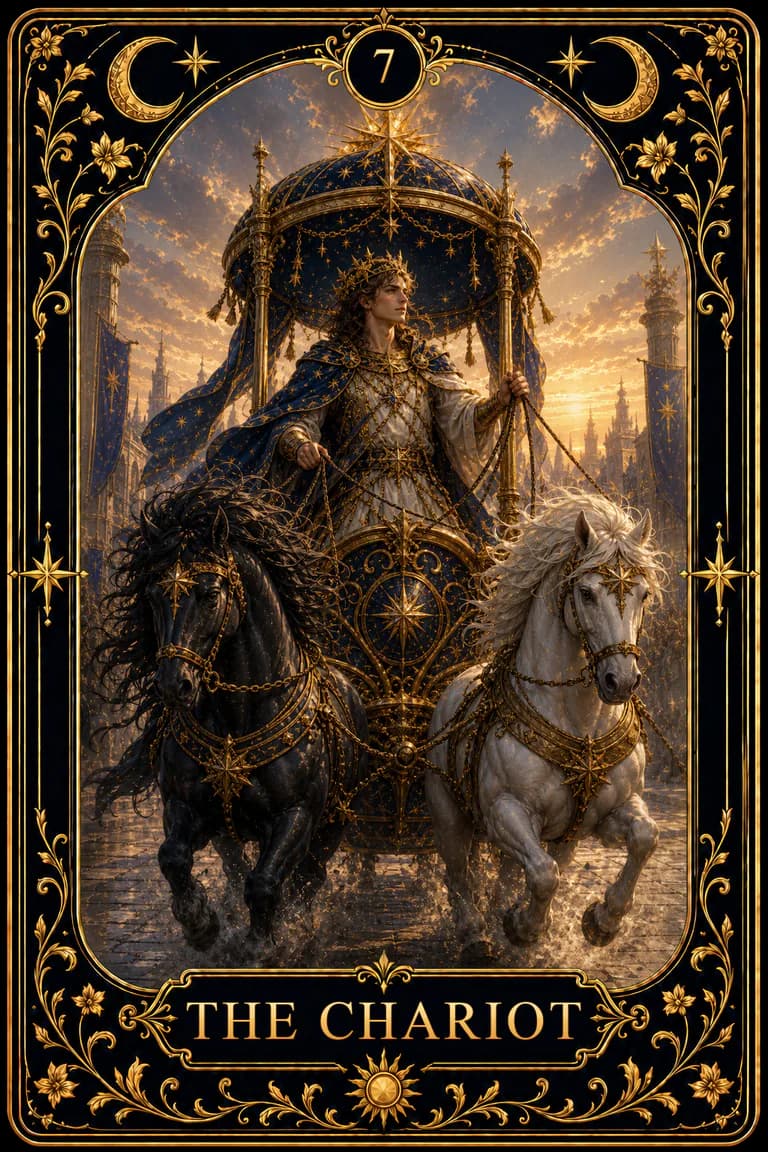
The person asking has a preliminary offer with slightly higher pay but no final contract. Rent is more expensive in the new city, where they know no close friends. Example draw: Past influence—The Chariot; Present—Two of Pentacles; Hidden influence—Five of Cups; Main obstacle—The Moon; External influence—Five of Pentacles; Guidance—Ace of Swords; Current-path outcome—Three of Wands.
The Chariot shows the move continuing a long-held wish to change environments actively rather than a passing impulse. The Two of Pentacles in the present shows that income, rent, moving costs, and existing responsibilities are not yet balanced into a stable budget. The Five of Cups in the hidden position suggests that the grief of leaving a familiar support network has not been included in the decision. It does not predict regret; it adds emotional cost to the plan.
The Moon as the obstacle closely matches the unresolved contract: unclear information is a greater risk than the city itself. The external Five of Pentacles emphasizes high living costs and limited initial support, but it does not guarantee financial hardship. The Ace of Swords therefore asks for clarity in writing: pay, probation, start date, and remote options, followed by a new calculation using actual rental listings.
The Three of Wands suggests room for expansion and a new horizon if the information becomes firm and the budget is workable. It is not a promise of success at a distance; it is prepared exploration. If the contract remains vague or the budget has no buffer, the verification in Card 6 may reasonably change the moving date.
Before signing a lease or paying a deposit, obtain a written contract covering pay, probation, and start date. Build three monthly budget scenarios from real listings and identify at least two sources of social or practical support after arrival, then decide whether the original moving date still works.
Common misreads
- Turning the hidden influence into a secret enemy or third party before checking missing information, personal needs, and assumptions
- Confusing the main obstacle with external influence and blaming the environment for every part that could be adjusted
- Treating Card 7 as a fixed ending without naming its conditions or how guidance from Card 6 might redirect the path
Frequently asked questions
Does the last Horseshoe card predict the final outcome?
It describes the direction of the current path if existing conditions continue, not an unchangeable ending. New information, environmental change, and your actions can all alter the scenario.
Does a hidden influence mean someone is keeping a secret from me?
No. It more often means a condition not yet included in your judgment, such as missing information, an unacknowledged need, or an untested assumption. Confirm anything involving another person through observable facts and direct communication.
Should I choose the Horseshoe or Celtic Cross?
Choose the seven-card Horseshoe to follow one situation through time and environment. Use the ten-card Celtic Cross when conscious goals, underlying drives, hopes, and fears also need detailed attention.
See the arc—and where the arc can still change
Bring one situation with several moving parts into seven cards. The Horseshoe separates history, undercurrents, obstacles, and environment, then reads the trend as a path that remains adjustable.
Use the cards to make sense of the moment; leave the final judgment to observable facts, your boundaries, and your next actions.